Navajo Pottery Story Teller with Children

     Navajo Pottery "Cheyenne Jim" Story Teller with Children


The story of Cochiti Pueblo artist Helen Cordero is inextricably linked to the art of figurative clay sculpture . . . for it is she who gave new shape to an ancient form. According to Barbara Babcock, author of The Pueblo Storyteller: Development of a Figurative Ceramic Tradition published by the University of Arizona Press, 1990. Helen's story is as follows:

"When Helen Cordero began making clay persons in the late 1950s, she was 45 years old, the six children she had raised were grown, and she was doing beadwork and leatherwork with her husband's cousin, Juanita Arquero, to make a little extra money. Most of the profits, however, had to be used to buy more materials.


"Why don't you girls go back to the potteries?" Fred Cordero's aunt, Grandma Juana, asked. "You don't have to buy anything; Mother Earth gives it all to you."

And so, Juanita, who had learned to make pottery as a child, "started up again" and Helen spent six months learning the ancient art from her. Juanita was already an accomplished potter, and in comparison, Helen's bowls and jars didn't look right. "They just kept coming out all crooked, and I was ready to quit," said Helen. "I didn't think I would ever get it right."


Juanita suggested that Helen try figures. "It was like a flower blooming," said Helen. Small frogs, birds, animals and, eventually, "little people" came to life in abundance.

One of the first times Helen showed them at a Santo Domingo feast day, folk art collector Alexander Girard of Santa Fe bought all of the "little people" (standing male and female figures, 8 to 9 inches high) that she had; he asked her to make more and larger figures and bring them to him. Shortly thereafter he commissioned a 250-piece Nativity set.


Girard then asked Helen to make an even larger seated figure with children. Perhaps he was thinking of the "Singing Mothers"--figures of women holding or carrying a child or two that several Cochiti potters were making. Helen went home and thought about Girard's request. "I kept seeing my grandfather (Santiago Quintana). That one, he was a really good storyteller, and there were always lots of us grandchildren around him." Santiago Quintana was also a leading member of one of the clown societies and amucho sabio. And he was a valued friend and collaborator to several generations of anthropologists and observers of Pueblo life: He wanted his traditions preserved and maintained, and he went to great lengths to ensure that "they got it right." When Helen remembered her grandfather's voice and shaped that first image of him telling stories to five grandchildren, she made two significant modifications in the Singing Mother tradition: (1) She made the primary figure male, rather than female, and (2) she placed an unrealistic number of children on him. Subsequent Cordero storytellers have had as many as 30."

That was 1964 and the grandfather figure with five children was the first storyteller. As a portrait of Helen Cordero's grandfather, it is a self-portrait as well, since she is one of the children. The first storyteller is part of the Alexander Girard Collection in the Museum of International Folk Art remote in Santa Fe. Today, as many as three hundred potters in thirteen pueblos have created storytellers . . . and the storytellers are not only men and women, but also mudheads, koshares, bears, owls and other animals . . . often with children numbering more than one hundred!


The First Storyteller

Helen Cordero
The First Storyteller 1964
Slipped and painted earthenware
8.25 inches Ht
Alexander Girard Collection
Museum of
International Folk Art
 remote
Santa Fe

By Pamela Michaelis, founder of The Collector's Guide and former host of “Gallery News” radio show on KHFM 95.5 remote, classical radio in Albuquerque.


4TH GRADE


NATIVE AMERICAN 

STORYTELLERS

Everyone Loves 

Storyteller Dolls

Storytellers began    around 1958 at Cochiti Pueblo. This pueblo is well-known for making figures and animals. The story teller figure depicts an elder telling the children the legends of their people. Since there was no written language, storytelling provided an important social and cultural function and perpetuated ethnic identity. The storyteller doll has become a means of keeping an awareness alive. Other pueblos make storytellers, each developing their own interpretation,

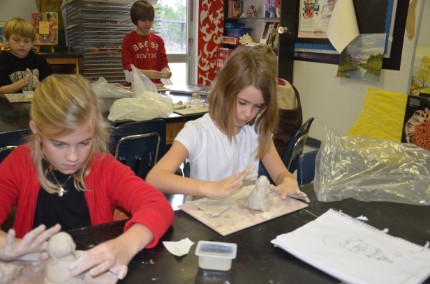
The Pueblo people have a great tradition of clay sculpture; they were especially good at creating small figures of people or animals. The Pueblos combined their sculpture skills with their love of storytelling and began a tradition of creating "storyteller dolls." Students will discuss the process of storytelling and listening to stories, then create a listening doll in the tradition of the Native American storyteller dolls.


UNIT:  SCULTPURE

The Pueblo people have a great tradition of clay sculpture; they were especially good at creating small figures of people or animals. The Pueblos combined their sculpture skills with their love of storytelling and began a tradition of creating "storyteller dolls." Students will discuss the process of storytelling and listening to stories, then create a listening doll in the tradition of the Native American storyteller dolls.


OBJECTIVES & CONCEPTS

Students will:

          Learn about Pueblo Indian storyteller dolls.

         Create a storyteller doll.

         Understand the basic ways of working with clay. 

          Create and write a story for their StoryTeller.

         Be able to explain good listening skills.

         Discuss the process of storytelling.

         Discuss and assess the various listening dolls created by the class.


PROCEDURE

1. Tell students that they will be creating their own listening dolls.   Demonstrate how to roll, mold, and attack pieces of modeling clay.

2. Distribute clay to the students

3. Remind students that the listening dolls should be small and portable. 4. The target size should be between 5 and 7 inches, from head to toe. 

5. Direct students to begin shaping the body of the doll. 

6. After the figures are completed, students will paint their sculptures.

EVALUATION

-Were students successful in sculpting a Storytelller?

-Did they create a story with a moral?

-Class Critique

-Self - Evalutation


VOCABULARY 

Clay
Greenware

Slip

Welding

Scoring

Sculpture

Statue

Storyteller 

Sculpture

3-Dimensional

Handbuilding


CURRICULUM INTEGRATION

This Unit was integrated with Computer Class, English and Social Studies.


https://www.facebook.com/media/set/?set=a.318441728201404.

73023.313475302031380&type=3


This free website was made using Yola.

No HTML skills required. Build your website in minutes.

Go to www.yola.com and sign up today!

Make a free website with Yola